

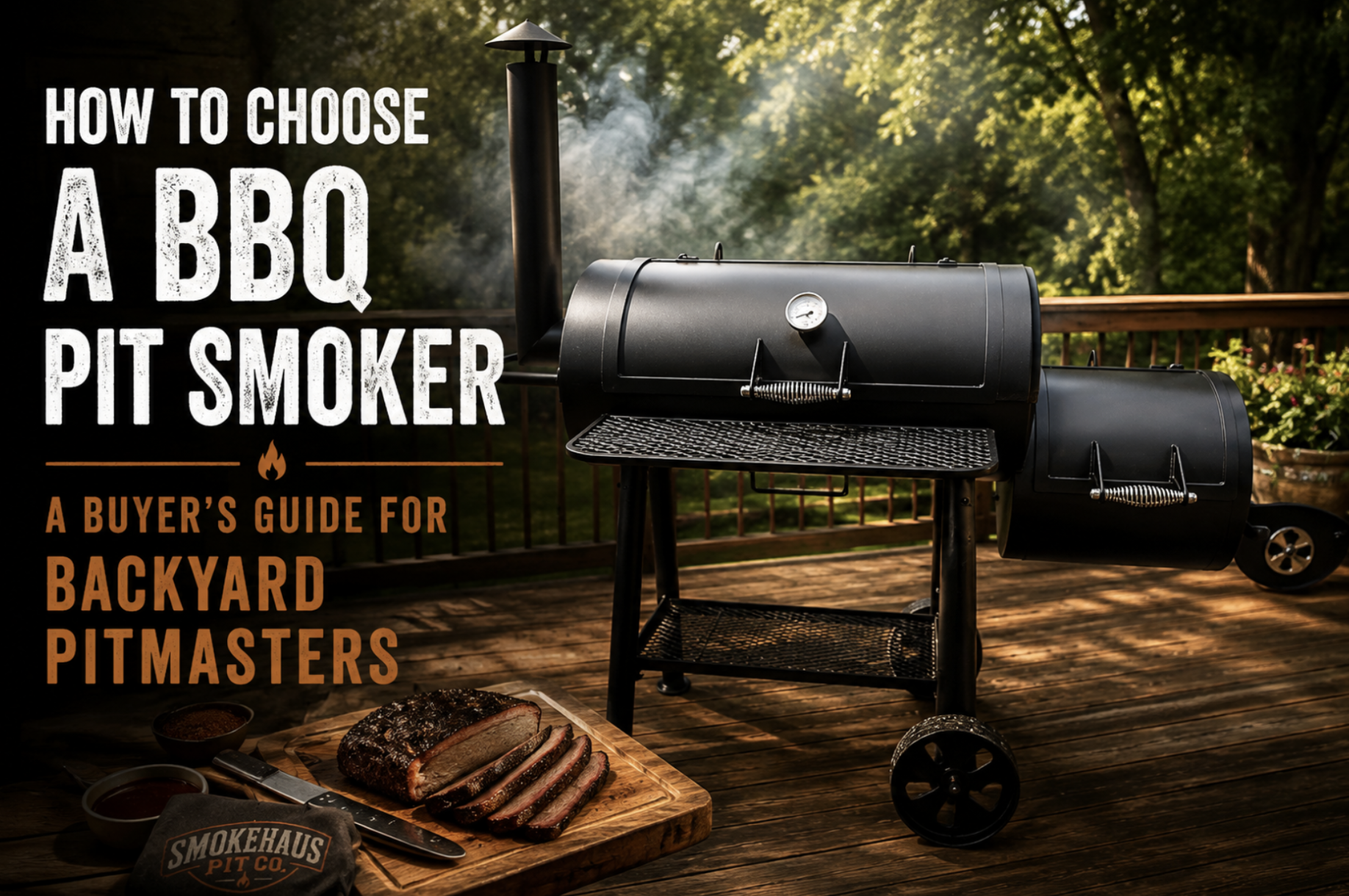
Choosing your first serious BBQ pit smoker is a bigger decision than buying a grill. A good BBQ pit is built to last years and to turn out brisket, ribs, and pork shoulder that bring everyone back for seconds. This guide walks through what actually matters when you choose one, and uses the Smokehaus Pit Co. Smoker/Grill as a working example along the way.
The first question is what style of cooking you want. If you’re after authentic, low-and-slow barbecue with real wood-fired flavor, an offset smoker is the traditional choice.
On an offset smoker, the firebox sits to the side of the main cooking chamber rather than underneath it. Heat and smoke travel from the firebox across the chamber, so the food cooks by indirect heat instead of sitting over the flame — the gentle method that gives barbecue its even cook and smoky flavor. It’s worth knowing there are two common offset designs: a traditional (true) offset, where the firebox opens directly into the chamber, and a reverse-flow design, where smoke first travels under a baffle plate before rising into the chamber to even out the heat.
The Smokehaus BBQ Pit is a true offset: the offset firebox delivers authentic indirect heat for low-and-slow cooking, and it doubles as a charcoal or wood-fired grill when you want to sear directly over live coals.
If you remember one thing from this guide, make it this: the thickness of the steel is the single biggest factor in how a smoker performs.
Heavy-gauge steel acts like a thermal battery. It holds heat, smooths out temperature swings, and uses less fuel over a long cook, while thin metal bleeds heat constantly and struggles to hold a steady temperature in cool or windy weather. The barbecue community generally treats ¼-inch steel as the gold standard for serious offset smokers.
It’s also worth checking whether the body is welded. Fully welded seams keep heat and smoke from leaking out, which helps hold a consistent temperature.
The Smokehaus BBQ Pit is built from heavy-duty ¼-inch steel throughout the cooking chamber, firebox, and lid, with a fully welded body and firebox and flanged lids that help seal in heat and smoke.
Cooking area is usually measured in square inches, and how much you need depends on how many people you cook for. As a planning rule, count on roughly ⅓ to ½ pound of cooked meat per person, adjusting up if barbecue is the main event and down if you’re serving several proteins and sides. A single brisket or a few racks of ribs takes up real estate, so more chamber space means more food finished at once — and fewer back-to-back cooks when you’re feeding a crowd.
The Smokehaus BBQ Pit offers 1,005 square inches of total cooking space: 731 square inches in the main chamber across two levels of cooking racks, plus 274 square inches on the firebox grate. Because the firebox grate can run at the same time as the main chamber, you can smoke and grill together.
Offset smokers typically burn charcoal, briquettes, or wood. Charcoal burns steadier and is easier for beginners to manage; wood gives the most authentic flavor. Many pitmasters run a charcoal base and add wood for smoke.
The wood you choose shapes the flavor. A few common hardwoods:
The Smokehaus BBQ Pit runs on charcoal, briquettes, or hardwoods, and Smokehaus specifically recommends oak, hickory, pecan, or mesquite so you can match the wood to the flavor you want. It isn’t designed for pellets or gas.
Low-and-slow barbecue is all about holding a steady temperature for hours, so airflow control matters. On an offset, you regulate heat and smoke by adjusting how much air feeds the fire and exits the stack. Two things make that easier: good dampers, and a thermometer mounted where the food actually cooks rather than at the top of the lid.
The Smokehaus BBQ Pit uses two damper controls — a butterfly damper and a chimney control — to fine-tune airflow, heat, and smoke. Its thermometer sits near the cooking grate, so you read the temperature where your food sits, not just at the top of the chamber.
The features that don’t show up in a headline are the ones you’ll appreciate on your tenth cook:
A warranty tells you how much confidence the maker has in the build. Read what’s covered and what isn’t.
The Smokehaus BBQ Pit carries a limited lifetime warranty against burn-out on the main cooking chamber and firebox, for the original residential purchaser. It excludes items like meat grills, fire grates, legs, handles, smokestacks, and wood grates, and it does not cover rust, so keeping the steel protected from moisture is on the owner. A dated sales receipt is required for warranty service.
| Specification | Detail |
|---|---|
| Type | True offset smoker (firebox doubles as a grill) |
| Construction | Heavy-duty ¼-inch steel, fully welded |
| Total cooking area | 1,005 sq. in. (731 main chamber over two rack levels + 274 firebox) |
| Fuel | Charcoal, briquettes, or hardwood (oak, hickory, pecan, mesquite) |
| Temperature control | Butterfly damper + chimney control; grate-level thermometer |
| Storage | Waist-high work shelf + lower wood shelf |
| Mobility | Oversized laser-cut steel wheels |
| Shipping weight | ~485 lbs. |
| Overall size | 64″ L × 27″ W × 52″ H |
| Warranty | Limited lifetime burn-out (chamber and firebox), original residential purchaser |
| Price | $999 (regularly $1,499) |
The best way to judge a smoker is to stand next to it — feel the weight of the steel, open the lid, look at the welds. Tree Frogs displays the Smokehaus BBQ Pit across showrooms in Houston, Dallas-Fort Worth, Austin, San Antonio, Texas, and Arizona, with delivery and installation available. Find your nearest location, or read more on the Smokehaus Pit Co. Smoker/Grill product page.